
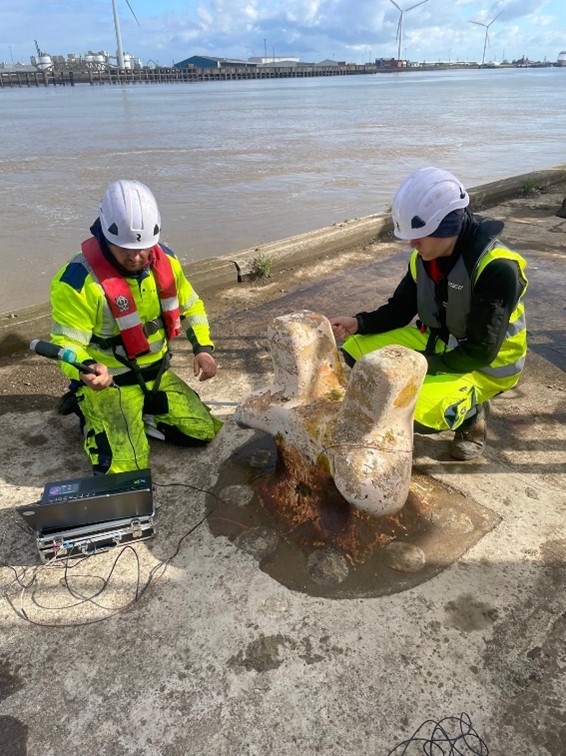
Bollard Proof Augments Its Site Offering With Modal Testing Ensuring quayside mooring assets are safe, reliable, and fit for purpose is essential. One older technique in the industry is modal (‘hammer’) testing; Hammer testing has been used in the casting industry for hundreds of years to verify the integrity of cast metal objects. Modal testing techniques were developed during WW2 to look for signs of fatigue and cracking in aircraft. Modern day modal testing sees marine bollards struck with an electronic hammer. The resulting signal is analysed for signs of voids or cracks in the structure of the casting. While this method can provide insight into the resonance characteristics of the material, it has limitations in that it cannot replicate the forces experienced during real ship mooring, and results can be difficult to interpret without complementary testing.
At Bollard Proof, we have developed a highly adaptable modern alternative that accurately simulates real-life conditions. Our portable test rigs replicate the way ships’ mooring ropes load bollards, pulling at combined vertical and horizontal angles. Loads can be applied up to a bollard’s rated working capacity (or 10% beyond), with a calibrated load pin directly measuring the force and lasers monitoring the bollard for signs of bending or movement in the anchorages.
Inevitably, some bollards are situated in confined spaces, which preclude the use of our mobile test rigs. Provided there are bollards of the same type and capacity nearby, a proof load and modal test can be undertaken to provide known benchmark data against which any inaccessible bollards can be corroborated. In isolation, modal testing cannot be used to verify or certify the working load of bollards, but Bollard Proof’s unique approach allows us to deploy this dual methodology, providing our clients with a comprehensive suite of test results against which to categorise and manage their mooring assets.
Other methods, such as tug-assisted or bollard-to-bollard pull testing, introduce uncertainty and risk. They don’t replicate real-world loading and can be dangerous if a bollard fails under load. Our rigs address these issues with a compact, adaptable design that ensures both accuracy and safety. By developing a safer, more realistic testing method and supplementing it with occasional modal testing, Bollard Proof provides trusted verification that quayside bollards will perform as expected.
Our focus remains on client satisfaction, adherence to international standards, and operational safety, ensuring that every bollard we test is fit for purpose under real-world mooring conditions. Our site operatives are fully trained in performing the tests and interpreting the results. If you would like to find out more about the science of modal testing, please make contact with us at